+250% Weekly Clicks After Removing Visibility Debt | GrowthRadical Case Study

A healthcare credentialing firm was doing everything right — except the one thing search engines actually read.
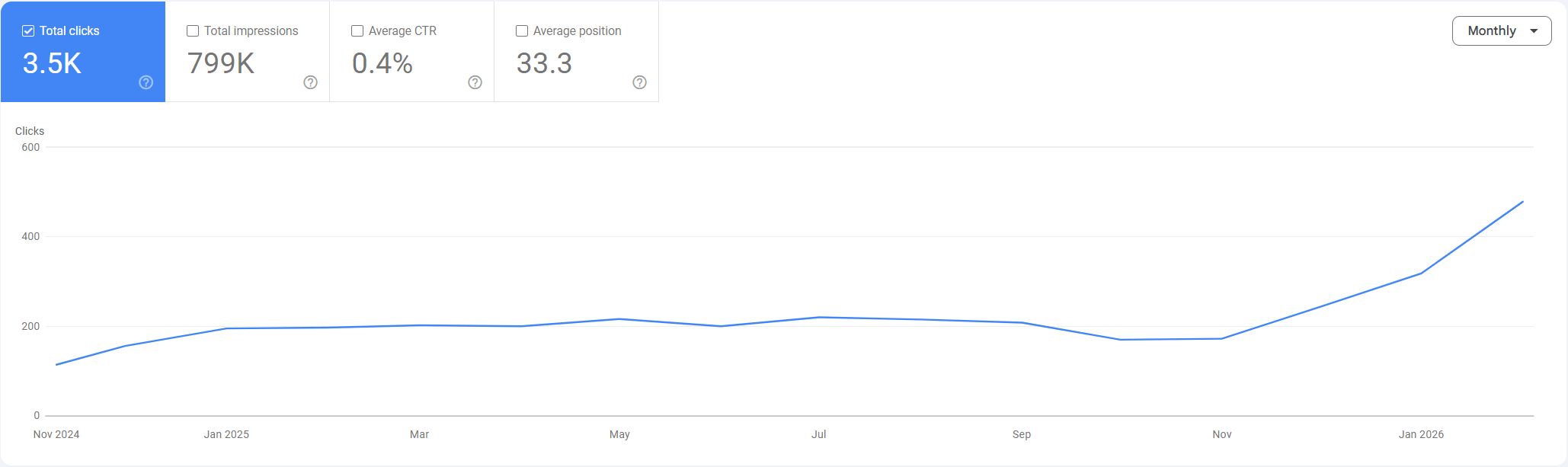
Healthcare credentialing visibility debt case study — click and impression growth chart

+250% weekly clicks after removing visibility debt.

A healthcare provider enrollment and credentialing firm had search demand, but growth was capped by conflicting entity signals, uneven structured data, and technical friction that reduced how consistently the site was processed and presented.

Clicks / week
40 → 140
+250%
Avg. position
20 → 12.2
Improved ~8 positions
Impressions / week
10k → 20k
2x visibility

Once the site stopped contradicting itself, metrics moved fast.

Topical cluster lift

Page / Cluster Click lift Position change
CAQH compliance cluster
State release form explainer +177 clicks ~6 → 4.2
CAQH number explainer +29 clicks ~10.6 → 7.6
Medicaid provider enrollment cluster
Florida enrollment guide +73 clicks
Texas enrollment step-by-step +25 clicks
Georgia enrollment guide +16 clicks
HMO fundamentals cluster
Avoid common pitfalls +10 clicks ~5.8 → 3.8
Understanding HMOs +7 clicks ~7.1 → 6.4

This was not a “publish more blogs” situation.

The site already had demand. But the interpretation layer was working harder than it should because the site kept contradicting itself across business identity signals, structured data, and page templates.

When a business’s on-page identity, structured data, and location signals do not align cleanly, the outcome is predictable: rankings plateau, snippets become inconsistent, and “almost page one” pages stay stuck.


What we found

We audited entity signals, structured data, indexing mechanics, performance constraints, and page-level intent alignment.

01
Entity and identity conflicts
Business name/address/phone details were inconsistent across on-page contact elements, structured data, and location references. Non-production contact data inside schema added ambiguity.
02
Structured data gaps and misclassification
Important properties reinforcing real-world presence were incomplete. Some schema types did not match the page’s primary purpose, lowering signal quality.
03
Indexing and snippet noise
Templates had conflicting metadata patterns including duplicated description tags. Heading structures reduced consistency and maintainability.
04
Performance and rendering friction
Excessive request weight, render-blocking scripts, and ungoverned third-party script load expanded both performance cost and operational risk.

Several high-demand pages were also close to visibility breakouts but needed sharper intent alignment, better topical coverage, and stronger internal reinforcement from related pages.


Trust and clarity first, then scale relevance.

We sequenced the backlog around what unlocks compounding outcomes, not what is easiest to ship. Each phase had to clear before the next could produce reliable lift.

PHASE 01
Entity consistency
Reduce identity ambiguity so the search engine can reconcile the business as a single, coherent entity across all surfaces.
Why first
Every downstream signal depends on Google confidently identifying who this business is. Contradictory NAP, non-production emails in schema, and inconsistent naming created hesitation at the foundation layer.
Key moves
Aligned name/address/phone across on-page elements, schema, and GBP. Replaced staging-domain email with production contact. Expanded markup with contactPoint, sameAs references, geo coordinates, and corrected openingHoursSpecification.
PHASE 02
Technical clarity
Ensure templates produce clean, consistent signals so indexing and snippet generation stop fighting noisy inputs.
Why second
With entity resolved, the next bottleneck was template-level noise: duplicated meta descriptions, schema type mismatches, and missing hierarchy signals. These made indexing unpredictable and snippet quality inconsistent.
Key moves
Corrected schema types to match page purpose. Eliminated duplicate description tags. Standardized heading structures across templates. Added BreadcrumbList for hierarchy comprehension.
PHASE 03
Performance triage
Remove rendering friction so crawl-to-index happens reliably and page experience signals stop dragging competitive edges.
Why third
Entity and template signals were clean, but pages still carried excessive request weight and render-blocking scripts. In competitive SERPs, page experience becomes a tiebreaker. Render delays also slow the crawl-render-index pipeline.
Key moves
Identified render-blocking scripts and guided async/defer loading for non-critical resources. Reduced request bloat through asset consolidation. Tightened third-party script governance to reduce both performance cost and operational risk.
PHASE 04
Page upgrades + cluster linking
Turn individual high-opportunity pages into compounding topical clusters through intent alignment and internal reinforcement.
Why last
Content upgrades without clean entity, template, and performance foundations waste effort. With those resolved, page-level changes could compound: better titles, sharper intent match, and internal links that clarify relationships across supporting pages.
Key moves
Upgraded titles and on-page structure on pages already earning impressions. Built crawlable internal links with descriptive anchor text between cluster pages. Improved topical coverage on high-demand pages close to breakout positions.

What we guided the team to ship

Prioritized backlog with Impact / Effort / Risk scoring. Dev-ready guidance across four workstreams.

Entity + trust alignment
Aligned naming/address/phone representation across key surfaces. Replaced non-production contact data with real business details. Expanded entity markup with contactPoint, sameAs references, geo specificity, and corrected openingHoursSpecification formatting.
Structured data + technical hygiene
Corrected schema types to match page purpose. Fixed formatting likely to be ignored. Added BreadcrumbList. Eliminated duplicate description tags. Standardized template patterns generating inconsistent signals.
Performance triage
Identified render-blocking scripts and guided deferral for non-critical resources. Reduced request bloat through asset consolidation. Tightened third-party script governance.
Page and content upgrades
Upgraded titles and on-page structure on high-opportunity pages already earning impressions. Reinforced internal linking across supporting pages so topical clusters compound instead of operating as isolated URLs.

Turn the gaps into a scalable system.

Fixing contradictions unlocks lift. Keeping lift requires a repeatable structure. The job now is to map exactly what is missing in the information architecture, then ship templates and a content system that can scale without quality drift.

STEP 01
Build the structure gap map
Know what coverage is missing, where it belongs, and what should be consolidated.
How we know the gap
We combine keyword + SERP demand with your existing URL inventory, then classify each query into intent components (definition, steps, requirements, cost, timelines, state-specific variants, FAQs). Anything with demand that has no clean home becomes a structural gap.
Output
A coverage matrix: query set → target template → supporting modules → internal links → existing URL match or new URL.
STEP 02
Create templatable UX elements
Make pages feel complete and consistent, without rewriting everything by hand.
What we template
Reusable modules that plug into any service/state page: eligibility checklist, required documents, timeline steps, pitfalls block, state selector, comparison tables, FAQ accordion, trust block (entity signals), and next-action components.
Why it matters
Templates reduce production variance. They also make it easier for search engines and AI systems to extract stable answers because the same intent components appear in predictable places.
STEP 03
Deploy a custom content writing agent
Scale content with governance, not chaos.
What the agent does
Generates pages that follow your templates, write in your voice, enforce entity rules (NAP consistency, contact schema correctness), and attach the right internal links for the cluster. It also produces title/meta variants that match intent instead of generic filler.
Quality controls
Built-in checks: duplication detection, missing intent component warnings, schema validation rules, and “no contradictions” constraints across templates.
STEP 04
Governance + measurement loop
Catch drift early and keep compounding.
What ships
A refresh workflow for the coverage matrix, a change log for templates, and a dashboard that tracks cluster-level progress (impressions, clicks, positions, and pages stuck at breakout thresholds).
Outcome
The team can scale safely because the system tells them what to build next and how to build it, without reinventing the rules every sprint.

Bottom line: the win is not “more content.” The win is a structure that makes the right pages inevitable, plus templates and an agent that can produce them consistently.


Clarity, not magic.

The site started winning when:

Business identity signals became consistent enough to interpret confidently.

Structured data and template signals stopped fighting each other.

Performance friction dropped, so rendering and indexing became more reliable.

Cluster pages reinforced each other through crawlable internal linking and intent-aligned upgrades.

Google does not reward effort. It rewards clarity. This engagement removed the contradictions that capped growth, and the site’s existing demand did the rest.

Your site might be contradicting itself right now.

Submit one URL. We return a structured Visibility Scan in 48 hours: score, gap map, prioritized actions, and dev-ready tickets.